
TPO — the default
White and reflective, so it drops summer deck temperatures and cooling load. Hot-air welded seams are stronger than the sheet itself. Best value per square on open warehouse, retail and office decks.
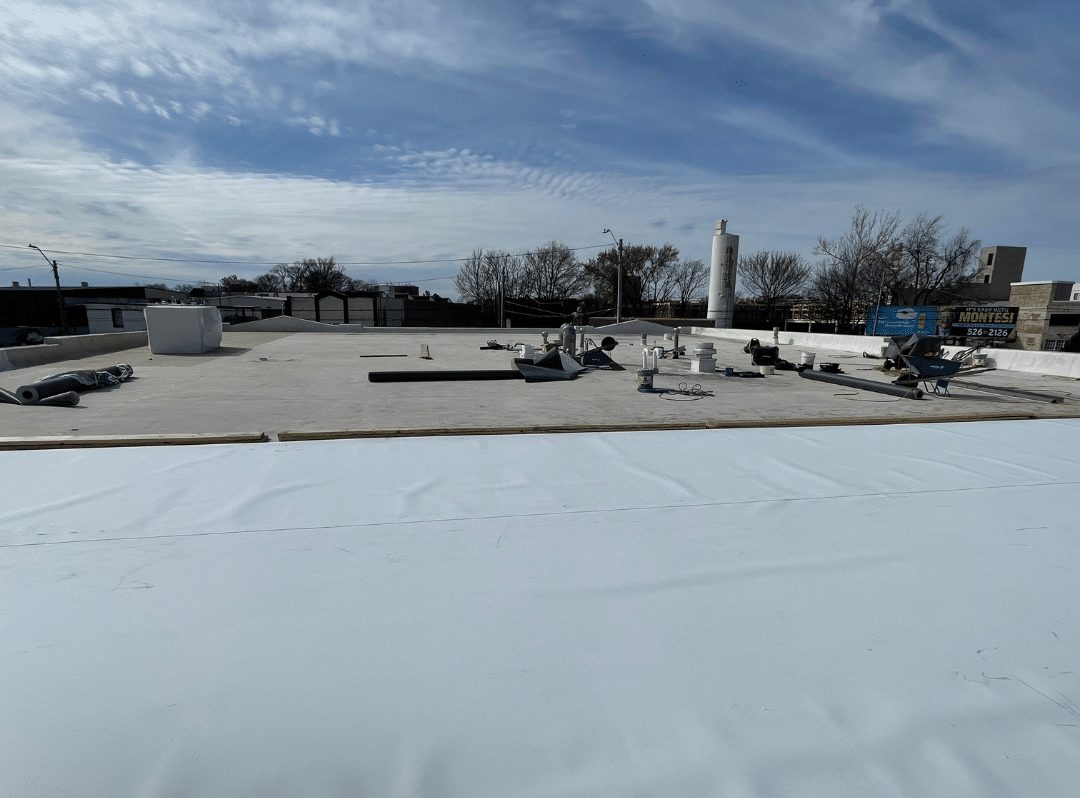
TPO roofing detailsFor most St. Louis commercial buildings TPO is the default: white, reflective, welded seams, mid-range cost. EPDM makes more sense on a shaded or heavily penetrated roof where flexibility beats reflectivity. PVC is the one to specify when grease, chemicals or constant foot traffic are in play — restaurants, plants and hospital kitchens. John Beal Roofing spec's whichever one the building actually needs and prices all three when it's a close call. Free inspections. Call (314) 429-6000.
Every membrane salesman in the Midwest has a favorite, and it is usually the one their supplier stocks. That is not a spec. What matters is what sits on your roof, what runs through it, and how much sun and hail the deck takes in a St. Louis year.
The three membranes below all belong to the same family — single-ply sheets, mechanically fastened or fully adhered, seamed on site. Where they split is chemistry, and chemistry is what decides whether you are re-roofing in fifteen years or twenty-five.
White and reflective, so it drops summer deck temperatures and cooling load. Hot-air welded seams are stronger than the sheet itself. Best value per square on open warehouse, retail and office decks.
TPO roofing detailsBlack rubber, extremely flexible, and forgiving around dozens of penetrations. It handles freeze-thaw cycling better than anything else and is easy to patch decades later. Weak spot is heat gain.
EPDM roofing detailsThe only one of the three that shrugs off animal fats, grease and many solvents. Specify it over restaurant kitchens, food plants and anywhere exhaust drips back onto the roof.
PVC roofing detailsMissouri hail is the variable nobody east of here has to price. Thicker sheets and fully adhered assemblies take strikes better; 45 mil on an exposed roof is a false economy here.
Storm and insurance claimsEPDM is usually cheapest installed, TPO sits close behind and wins on energy, PVC runs highest. Over a 25-year hold the gap narrows enough that first cost is the wrong thing to decide on.
What commercial roofs costAll three come in 15, 20 and 30-year manufacturer terms. Read whether it covers labor and whether it's an NDL. A 30-year material-only warranty is worth less than a 20-year NDL.
Warranty guideTPO — high. PVC — high. EPDM — low, unless you pay for a white-backed sheet. On a big open deck in a St. Louis August that difference shows up on the utility bill.
PVC — excellent. TPO — moderate. EPDM — poor around petroleum and grease. Kitchen exhaust is the single most common reason a membrane dies early here.
EPDM — best. It stretches around curbs, pipes and odd geometry without fighting the crew. On a roof with forty penetrations that matters more than reflectivity.
Exhaust first. If there are kitchen hoods, fryer vents or process stacks, the membrane under the plume decides the whole spec, and that is usually PVC.
Then penetration count. A deck crowded with curbs, drains, conduit and old abandoned supports favors EPDM, because every one of those is a detail somebody has to seal.
Then sun exposure and deck type. A wide, open, unshaded metal deck is where TPO pays for itself twice — once in the install price and again every cooling season.
And finally the hold period. A building being sold in three years gets a different recommendation than a family-owned plant staying put for thirty.
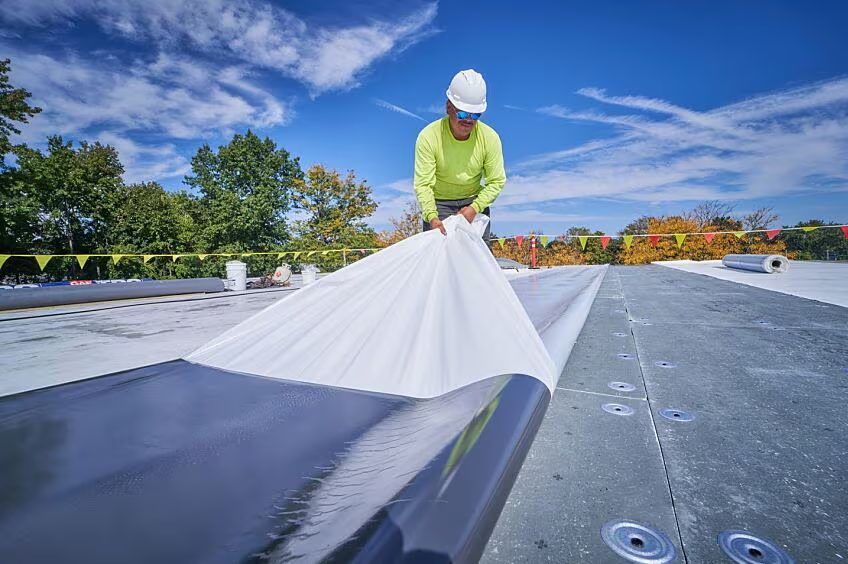
Properly installed and maintained, PVC and TPO both run 20 to 30 years and EPDM 20 to 25. Installation quality and maintenance move that number far more than the material choice does.
On anything under a few thousand square feet the energy saving is modest. The bigger argument for TPO on small roofs is welded seams and easier future repairs.
Often yes — a recover saves tear-off cost and landfill fees. Code allows two roof layers, the deck has to be sound and dry, and a moisture scan tells us whether it's an option.
Yes. We are not tied to one manufacturer, which is why we will quote two systems side by side when the building could reasonably take either.
On exposed St. Louis roofs we default to 60 mil and go to 80 mil where hail history or foot traffic justify it. 45 mil belongs on protected or short-hold roofs only.
Tell us about the property and a dispatcher will call to schedule. No cost, no obligation.
Commercial leaks do not wait for business hours. A live dispatcher answers around the clock and we get crews moving the same night.