
Best suited to
restaurants, commercial kitchens, food processing, and any roof taking grease or chemical exhaust.
PVC is a hot-air welded single-ply membrane that resists grease, chemicals and animal fats, which is why it goes on restaurants, food plants and buildings with heavy kitchen exhaust. It carries the same welded-seam strength as TPO with better chemical resistance. John Beal Roofing installs PVC across the St. Louis metro. Call (314) 429-6000.
restaurants, commercial kitchens, food processing, and any roof taking grease or chemical exhaust.
20 to 30 years, and it holds up where grease would destroy other membranes.
What the exhaust actually puts on the roof — the membrane under a kitchen hood ages faster than the rest of the field.
PVC costs more per square than TPO, and there are buildings where that premium is the cheapest decision available.
Chemical and grease resistance is the reason PVC exists on a commercial roof. Animal fats and cooking oils carried out through kitchen exhaust break down TPO over time, softening and degrading the membrane in a widening ring around the fan. PVC withstands that exposure. For restaurants, commissaries, food processing and any building with significant kitchen or process exhaust, this is the specification question that matters most.
PVC is inherently fire resistant rather than treated to be, which matters to some occupancies and some insurers, and its seams weld the same way TPO seams do: hot air, fused into a continuous sheet, probed for cold welds before the crew comes off the roof.
Plasticizers are the honest trade-off. PVC stays flexible because of them, and across decades they migrate out, which is what eventually makes an aged PVC roof brittle. Current formulations retain them far better than the products that gave PVC a poor reputation in the 1980s, but it remains the material's aging mechanism and it is worth understanding before buying.
Compatibility is the detail that bites people. PVC and asphalt are not compatible, so PVC installed against an old modified bitumen or built-up surface requires a separator sheet between them. Skipping it produces a slow failure that surfaces years later and gets blamed on almost anything else.
On re-roofs over existing membrane we core the assembly first to see what is actually stacked up and whether the insulation below is dry. A premium membrane installed over wet insulation is expensive money spent sealing in a problem.
Where there is no grease, no chemical exhaust and no fire-rating driver, we will say so and quote TPO instead. Specifying PVC on a plain warehouse spends a client's money solving a problem that building does not have.
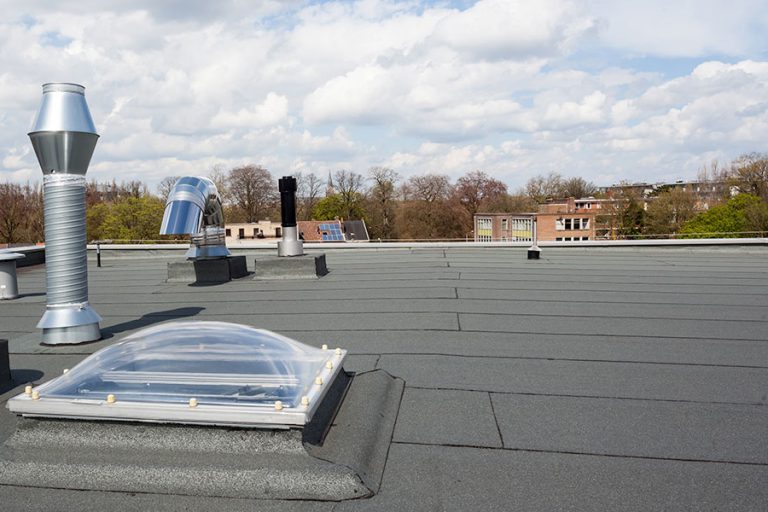
Membrane failures are almost never in the middle of the sheet. They begin at the details: curb flashing, pipe boots, wall terminations and drains.
That is where our crews spend their time, on the parts nobody takes pictures of. Seams go fast. Curbs, rebuilt properly, take an afternoon, and they are what gets a roof to year twenty.
Registration of the manufacturer warranty is part of the job, putting coverage on record under your address instead of in a drawer.
Related: TPO vs EPDM vs PVC compared
Twenty-five to thirty-five years is a reasonable expectation, and PVC's advantage shows most on buildings where grease or chemical exhaust would have shortened a TPO roof considerably.
Usually, with one firm condition: PVC cannot sit directly against asphalt. Over an old built-up or modified bitumen roof a separator sheet is mandatory, and the insulation still has to test dry before anything goes over it.
Yes. PVC welds much like TPO but is less forgiving on settings, and our crews are certified by the manufacturers whose systems we install, which is what allows a full system warranty to be issued.
Repairs weld cleanly and cost little. The replacement conversation on PVC usually arrives when the sheet has lost plasticizer and begun to stiffen, because a brittle membrane stops taking a reliable weld.
Attachment noise is the main intrusion, the same as any single-ply. No hot kettle and no torch, so buildings with air intakes near the roof — kitchens especially — are not dealing with odor migration during the work.
Tell us about the building and a dispatcher will call to schedule.
Commercial leaks do not wait for business hours. A live dispatcher answers around the clock and we get crews moving the same night.